
Whole Plasmid Sequencing reads across an entire plasmid to help researchers confirm what a DNA construct contains. Unlike a check of one short region, it can reveal changes across the backbone, insert, and junctions. That broader view matters when a plasmid has been assembled, modified, or propagated, because an unexpected base change may sit far from the region being checked. Small details matter.
The process generally begins with plasmid DNA preparation, followed by sequencing and computational analysis. Depending on the platform and project, short reads, long reads, or a combination may be used. Software assembles or maps the reads, then compares the resulting sequence with a reference or expected design. Researchers can review substitutions, insertions, deletions, and structural differences, while checking read coverage and sequence quality. A neat report is not a substitute for examining uncertain regions.
This article explains what Whole Plasmid Sequencing measures, how samples move from DNA to analyzed sequence, and what results can—and cannot—show. The method can provide strong evidence that a construct matches its design, but interpretation depends on sample quality, coverage, analysis settings, and the reference used. Some regions may remain difficult to resolve, especially when repeats or mixed populations are present. There is no single workflow that fits every plasmid. Understanding those limits helps readers choose an appropriate approach and ask better questions about the final report.
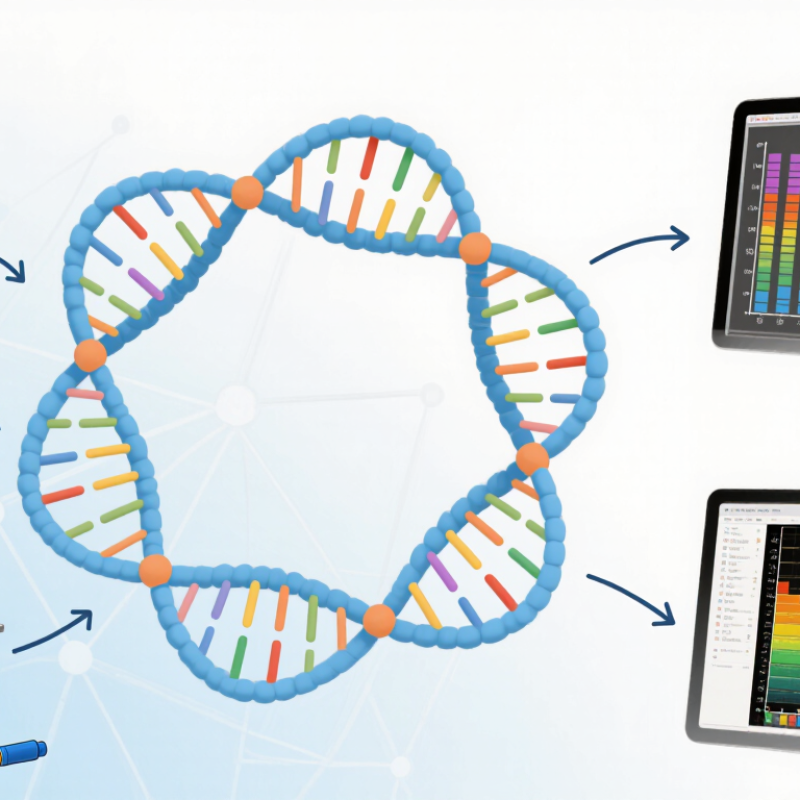
Whole plasmid sequencing determines the nucleotide sequence across an entire plasmid, rather than checking only a cloning junction or selected insert. It can cover the insert, regulatory elements, replication origin, selectable marker, and backbone. The aim is to confirm what is present and how these parts are connected. A complete sequence can reveal substitutions, missing bases, unexpected insertions, or rearrangements that a short target check may overlook.
That matters.
The scope depends on the question. For identity checks, the assembled sequence is compared with the intended design; for deeper characterization, researchers may inspect variants and structural changes. Short-read data can provide accurate base calls, while long reads can help resolve repeated regions and link distant features. Neither approach removes the need for quality control. DNA purity, sequencing coverage, and assembly choices can affect interpretation. In a 2019 Nucleic Acids Research resource paper, Galata and colleagues catalogued 21,701 plasmid sequences, illustrating the diversity of plasmid structures. That dataset is a reference, not a guarantee that every plasmid will assemble cleanly. Whole plasmid sequencing confirms sequence and structure; it does not, by itself, prove biological function.
Whole plasmid sequencing starts with a clean, well-characterized DNA sample. A single, verified colony is commonly grown in culture, then plasmid DNA is isolated using a method suited to the sample and sequencing platform. Gentle handling matters: repeated, forceful pipetting can shear DNA and complicate long-read analysis. Small details count.
The preparation should limit contamination from RNA, proteins, genomic DNA, salts, and leftover alcohol. These impurities can interfere with library construction or produce unreliable measurements. After extraction, measure DNA concentration with a method designed for double-stranded DNA. An absorbance reading can add context, but it does not prove that the sample is pure. A gel can reveal degradation or unexpected bands. No single check tells the whole story.
Before sequencing, confirm that the DNA amount and condition match the chosen library workflow. Requirements differ: some approaches favor intact plasmid molecules, while others call for specific end preparation. Avoid assuming that a high concentration means a good sample. It may not. Record the extraction method, sample identity, and quality checks, and use clean, clearly labeled tubes throughout. There is no perfect preparation, and low-level contamination can still escape routine checks. That uncertainty is worth noting when interpreting sequence results.
| Stage | What Happens | Why It Matters | Useful Checks and Considerations |
|---|---|---|---|
| 1. Select a colony | A single bacterial colony carrying the plasmid of interest is used to start a culture. | Starting from one colony helps reduce the chance of mixing plasmids from different bacterial populations. | Use the appropriate host strain and growth conditions for the plasmid. Follow the laboratory’s containment and handling procedures. |
| 2. Grow the culture | The selected colony is grown in liquid medium, commonly with the relevant selection agent, to produce cells containing plasmid DNA. | The culture provides enough cells for plasmid extraction. | Culture conditions and yield vary with the host strain, plasmid copy number, plasmid size, and growth conditions. |
| 3. Harvest and lyse cells | Cells are collected and lysed. Many plasmid miniprep methods use alkaline lysis, followed by neutralization. | Careful lysis releases plasmid DNA while allowing much of the chromosomal DNA, protein, and cell debris to be removed. | Avoid vigorous mixing after lysis where the protocol advises against it, because sheared chromosomal DNA can contaminate the preparation. |
| 4. Purify plasmid DNA | Plasmid DNA is separated from cell components, often using a silica membrane or another DNA purification method, then eluted in a suitable buffer or water. | Purification reduces contaminants that can interfere with library preparation or sequencing. | Residual salts, alcohol, RNA, proteins, or genomic DNA may affect DNA measurements and downstream sequencing performance. |
| 5. Assess DNA quality | DNA amount and purity are measured. Fluorometric assays estimate double-stranded DNA concentration; absorbance measurements can provide additional purity information. | Accurate input assessment helps determine whether the sample is suitable for the selected library-preparation workflow. | For relatively pure DNA, an A260/A280 ratio near 1.8 is commonly expected. Absorbance ratios are approximate and should be interpreted alongside other quality checks. |
| 6. Prepare the sequencing library | Purified plasmid DNA is processed according to the sequencing platform and library protocol. Steps may include DNA repair, end preparation, adapter attachment, or other platform-specific operations. | The library format enables DNA molecules to be recognized and read by the sequencing instrument. | Input amount, fragment handling, and library steps differ by platform and protocol. Follow the current protocol for the chosen method. |
| 7. Sequence the DNA | Sequencing instruments read DNA fragments. Long-read approaches can often produce reads spanning most or all of a plasmid molecule; short-read approaches produce shorter reads that are assembled computationally. | Whole-plasmid sequencing aims to assess the complete plasmid sequence, including its backbone and insert. | Long reads can help resolve repeated or structurally complex regions. Short reads can offer high per-base accuracy, but repeats may complicate assembly. |
| 8. Assemble and review | Reads are assembled or aligned against an expected plasmid sequence, then reviewed for sequence differences and coverage across the construct. | Analysis can identify substitutions, insertions, deletions, and unexpected sequence changes within the regions supported by the data. | Check that reads support the full plasmid, including junctions and repeated regions. Coverage and quality requirements depend on the analysis goal and sequencing method. |
| 9. Interpret the result | The assembled sequence is compared with the intended design or reference sequence, and any differences are evaluated. | This provides evidence about whether the sequenced plasmid matches the expected construct. | A sequence result describes the DNA molecules represented in the submitted sample; it does not by itself confirm expression, function, or biological performance. |
Whole-plasmid sequencing begins with purified circular DNA. Library preparation then makes the DNA readable by a sequencing instrument. Depending on the method, molecules may be fragmented or kept long, with adapters added to support read generation. Small detail, big impact. Short-read workflows produce many relatively short fragments, often as paired reads. They offer strong local evidence, but repeated sequences can make plasmid assembly ambiguous.
Long-read methods generate reads thousands of bases long, sometimes spanning an entire small plasmid. Wenger et al. reported a mean read length of 13.5 kilobases and 99.8% consensus accuracy in a 2019 peer-reviewed benchmark. Those results describe a specific study, not a guarantee for every sample. That distinction matters. Individual reads can contain errors, and low-frequency variants may be missed without adequate sequencing depth.
A practical workflow may use long reads to resolve plasmid structure and short reads to check individual bases. Software filters reads, builds a consensus, and evaluates coverage across the sequence. Analysts should also inspect circularization junctions, repeated regions, and unexpected insertions. I would not treat a clean consensus as proof that rare variants are absent; mixed colonies and uneven coverage can obscure them.
Whole plasmid sequencing reads DNA fragments across an entire plasmid, helping assemble its sequence and identify variants.
The chart shows representative read lengths, not fixed limits: Illumina paired-end reads are commonly 150 bases per read, while Nanopore read lengths vary widely and PacBio HiFi reads are often around 10–25 kilobases. Actual lengths depend on the sequencing run and sample preparation. Long reads can span plasmids; short reads can provide high-accuracy complementary data.
Whole plasmid sequencing aims to recover the full DNA sequence of a plasmid, including its backbone and inserted regions. The process begins with purified plasmid DNA and sequencing reads that cover its length. Long reads can help connect repetitive sections that are difficult to resolve. Short reads may add useful base-level accuracy. Both approaches have limits.
Assembly software sorts overlapping reads into a continuous sequence. For a circular plasmid, the ends should connect without leaving an unexplained gap. Researchers then inspect read coverage, base quality, and possible mixed sequences. A sharp drop in coverage can point to a missing region or an uneven sample. Small details matter. Assembly is not automatic truth; settings and read quality can influence the result.
Analysis compares the assembled sequence with the intended design or a reference sequence. This can reveal substitutions, insertions, deletions, or unexpected rearrangements. Annotation tools can help locate features such as replication origins and selectable markers. A circular map is reassuring, but it is not proof by itself. Review the underlying reads, especially around joins and repeated elements. Some ambiguous regions may still need targeted follow-up, and that uncertainty should be reported rather than hidden.
Whole-plasmid sequencing results are most useful when read as evidence, not simply as a polished sequence. Check whether the reported sequence covers the full circular molecule, including the junction where the ends meet. Then inspect read depth, ambiguous bases, and any disagreements between reads. A clean consensus can still hide a low-frequency variant.
Accuracy has more than one meaning. Wenger and colleagues reported median read accuracy of 99.8% for circular-consensus reads in a 2019 Nature Biotechnology study. That figure describes individual reads, not a guarantee that every assembled plasmid is correct. Consensus quality also depends on coverage, sequence composition, and whether conflicting reads were resolved. Small gaps matter. Repeats and high-GC regions can be difficult to assemble, so review them rather than assuming software filled them correctly.
Compare the sequence with the expected construct, checking insert boundaries, orientation, mutations, and backbone features. Pay close attention to one-base changes: a substitution may be real, but it may also reflect a sequencing or alignment error. Strong evidence includes consistent support across independent reads and a clear quality profile. If coverage drops sharply at a junction, or reads support competing versions, report that uncertainty and consider confirmation with another method. Interpretation is not always tidy. That caveat belongs in the record.
Contact Us