
Blog

You are here:

Who Are the Top Standing Mirror Wall Suppliers in China?

Choosing a Standing Mirror Wall supplier in China takes more than comparing catalog photos. A polished image can hide uneven edges, unstable supports, or packaging that fails during shipping. Buyers should look for clear product specifications, consistent quality checks, and evidence that a supplier can meet the intended order volume. Details matter.

Useful comparisons start with the mirror itself. Ask about glass thickness, reflective coating, backing, edge finishing, and any safety film. Then check frame materials, dimensions, mounting options, and whether custom finishes are available. These points affect appearance, handling, and installation. Small differences can matter.

A supplier’s process matters too. Request current product samples, inspection records, production timelines, and packaging details. For large mirrors, protective corner guards and secure cartons are not minor extras. They can reduce damage in transit. Still, sample quality alone cannot guarantee every production run will match. That deserves attention.

This guide examines Chinese suppliers through practical factors such as product range, manufacturing capabilities, customization, communication, and quality control. It does not treat “top” as a fixed ranking; the right partner depends on your market, design, order size, and service needs. Buyers should verify claims directly and clarify specifications before placing an order. A careful review takes time. It can also reveal gaps in a supplier’s documentation or responsiveness. Those gaps are worth discussing, rather than ignoring them for a lower quote. The goal is a dependable match, not a perfect promise.
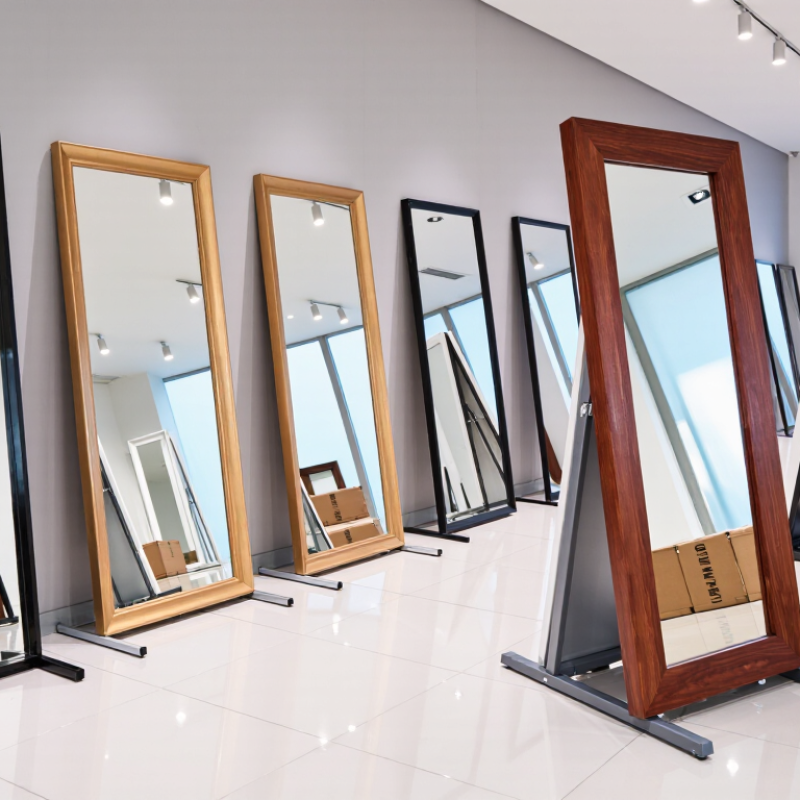
Who Are the Top Standing Mirror Wall Suppliers in China?

What Defines a Standing Mirror Wall Supplier in China?

A standing mirror wall supplier in China is defined by more than a low quotation or attractive product photos. The supplier should explain mirror thickness, glass type, edge finishing, backing, frame materials, and mounting options in clear specifications. Ask for a physical sample and production records. Check that the reflection is undistorted, edges are smooth, and the frame remains stable when upright.

Market context matters, but it is not proof of supplier quality. Grand View Research estimated the global furniture market at USD 736.59 billion in 2023; standing mirrors sit within this broader home-furnishings landscape, not as a separately measured category. A capable supplier should provide consistent measurements, traceable material details, and packaging designed to protect corners and glass during shipping. Request carton test information and inspect how replacement parts are handled. Details matter.

A polished catalog is not enough. Compare samples from different production batches, and ask how defects are recorded and corrected. Not every supplier will have perfect documentation; that is worth examining, not ignoring. Clear answers, repeatable quality checks, and realistic lead times are stronger signals than sweeping claims.

How to Evaluate Chinese Standing Mirror Wall Suppliers

Evaluating a Chinese standing mirror wall supplier starts with product details, not catalog photos. Ask for drawings showing dimensions, frame depth, mounting points, and wall-clearance needs. Request glass thickness, edge treatment, backing construction, and written inspection criteria. A sample lets you check reflections, corner alignment, and finish under ordinary room lighting. Look closely. Small waves or uneven gaps can be hard to spot on a screen. Ask how each mirror is packed, including corner guards and protective layers. A trial shipment can help assess the packaging.

Next, compare production evidence. Request recent quality records, material specifications, and photos of finished units before packing. Ask who performs inspections and how defects are documented; vague assurances are not evidence. Confirm lead times, minimum order quantities, replacement procedures, and how design changes are approved.

A supplier’s response to a difficult question may reveal more than a sales presentation. Still, one sample cannot prove every batch will match. Record agreed tolerances and packaging details in purchase documents, then inspect a pre-shipment unit when practical. Communication may feel slow at times. That deserves attention, but not necessarily an instant rejection.

Leading Standing Mirror Wall Suppliers in China

Leading Standing Mirror Wall Suppliers in China

Leading standing mirror wall suppliers in China are judged by more than polished product photos. Buyers should compare glass clarity, edge finishing, frame stability, packaging, and the supplier’s ability to repeat specifications across production runs. Ask for samples and inspect them under ordinary room lighting. Reflections can look different there.

Grand View Research estimated the global home décor market at USD 696.47 billion in 2023, with projected growth through 2030. This broad market figure is not specific to mirrors, but it signals demand across furnishing categories. For trade checks, UN Comtrade classifies glass mirrors under HS 7009. Importers can use this code to review reported trade flows, while remembering it covers more than standing wall mirrors. The distinction matters.

A capable supplier should provide measurable details: mirror thickness, frame material, carton dimensions, and drop-test information. Ask how corners and glass surfaces are protected; one crushed edge can spoil an otherwise sound shipment. Small details matter. Factory audits and clear defect-handling terms also help buyers compare offers fairly. Still, catalog claims are not proof. Request a current sample, verify the finish, and confirm that the approved specification will be used for the full order.

Who Are the Top Standing Mirror Wall Suppliers in China? - Leading Standing Mirror Wall Suppliers in China

Supplier categories and comparison criteria for sourcing standing and wall mirrors from China. This is a practical evaluation guide, not a ranking of named companies.

Supplier Category Typical Product Scope Potential Strengths Key Checks for Buyers Best Fit
Mirror-focused manufacturer Framed and frameless mirrors, full-length mirrors, wall mirrors, and floor-standing designs May offer a wider choice of mirror shapes, sizes, finishes, and frame materials Confirm glass thickness, mirror coating, edge finishing, frame construction, packaging, and available customization Buyers seeking several mirror styles from one product-focused supplier
Furniture and home décor manufacturer Standing mirrors integrated with wood, metal, or upholstered furniture-style frames Can be suitable for coordinated designs and matching furniture finishes Check frame material, stability, joining method, surface finish, tip-over precautions, and carton protection Retailers and project buyers looking for decorative or furniture-led designs
LED mirror specialist Illuminated mirrors with integrated lighting and, depending on the model, controls or electrical accessories May provide product-specific options for lighting, controls, and electrical configurations Request electrical specifications and applicable test documents; verify the IP rating against the intended installation environment Buyers sourcing illuminated mirrors for residential or commercial interiors
Glass processor with mirror fabrication Cut-to-size mirror glass, polished or beveled edges, and custom shapes May be appropriate for projects with non-standard dimensions or glass-processing requirements Confirm dimensional tolerances, edge-work samples, breakage controls, packing method, and whether finished frames are included Interior contractors and buyers with custom wall or architectural mirror requirements
OEM/ODM export supplier Private-label or customized mirror products, subject to the supplier’s production capabilities May coordinate product specifications, packaging, and export documentation for overseas orders Clarify which processes are performed in-house, sample approval steps, quality inspection criteria, order terms, and production schedule Importers and retailers developing a custom product or packaging specification

Products, Materials, and Customization Options

Chinese suppliers may offer full-length floor mirrors, leaner designs, and wall-mounted models. Match the structure to the room and installation method. Look closely. Ask about glass thickness, edge polishing, backing, and frame materials such as steel, aluminum, or solid wood. These details affect weight, stability, and appearance under bright light. Some listings sound precise but leave tolerances unclear. Request written dimensions and confirm them against a physical sample.

Customization can cover height, width, frame color, finish, beveling, corner shape, and packaging. Suppliers may also adjust stand angles or include mounting hardware, but confirm compatibility for each model. Small details matter. Ask for a sample showing the actual glass, frame joint, and rear support—not just a digital rendering. Before ordering, clarify carton protection, inspection steps, production lead time, and how defects are documented. Photos of a packed unit can reveal weak corner protection. Still, one sample cannot prove every production run will match. Use a signed specification sheet and keep a reference sample when practical.

How to Verify and Select a Supplier

Selecting a standing mirror wall supplier in China starts with evidence, not polished catalog images. Ask for a live video tour of the workshop and watch how mirrors are cut, edged, inspected, and packed. Request a sample made to your actual dimensions. Check its frame joints, rear backing, edge finish, and stability on an uneven floor. Small details matter. A supplier should explain glass thickness, frame materials, tolerances, and protective packaging in clear terms. Compare those answers with a written quotation and production schedule, not just a low unit price.

Before placing a larger order, ask for recent quality inspection records and references from buyers with similar products. Confirm who checks dimensions and cosmetic defects, and when those checks happen. Request photos of packed goods, including corner protection and the carton label. These details can reveal weak handling practices. Evaluate response quality, too: precise replies and prompt disclosure of limitations are more useful than broad promises. No checklist removes all risk. A sample may be excellent while batch consistency still needs monitoring, so agree on measurable acceptance criteria and a pre-shipment inspection. If specifications change, record the revision in writing; verbal agreement is easy to misremember.

Go to Top