
Blog

You are here:

China Top Carpet Cutter Manufacturers and Suppliers

China’s carpet-cutting sector serves flooring factories, fit-out contractors, and specialist workshops. A reliable Carpet Cutter must do more than make a straight cut. It should handle dense pile, backing fabric, and repeated production runs without excessive fraying or downtime. Small details matter: blade access, guide stability, operator visibility, and how quickly routine adjustments can be made.

For a transparent technical perspective, this introduction uses a fictional composite specialist, Lin Wei, rather than presenting an invented interview as fact. The composite’s practical advice is: “Judge a Carpet Cutter on the edge it leaves after a full shift, not just on its first clean cut.” It is a useful test. Still, one test cannot settle every purchase decision.

This guide examines China-based manufacturers and suppliers through product range, customization, quality documentation, service support, and communication. Buyers should ask for specifications, sample cuts, and clear details about replacement blades and maintenance. Photos can help, but they rarely show vibration, handling comfort, or performance on thick backing. Those points deserve direct checks. A low quoted price may look attractive; the real cost can change with shipping, spare parts, and production delays. No supplier fits every workshop. The comparisons ahead aim to make that choice more informed, while recognizing that published product information should be verified with each manufacturer.
China Top Carpet Cutter Manufacturers and Suppliers

What Carpet Cutters Are and How They Are Used

What Carpet Cutters Are and How They Are Used

A carpet cutter is a hand or powered tool for trimming carpet to fit rooms, stairs, and edges. Common options include utility knives, hook-blade knives, seam cutters, and powered trimmers. Installers often measure the floor, mark the backing, then cut against a straightedge on a firm surface. For a doorway, a short, controlled pass helps prevent cutting into the adjoining floor covering.

Blade choice matters. A hook blade can slice carpet backing while reducing the chance of catching the pile; a sharp straight blade is useful for clean edge trimming. Installers may cut from the back for straight runs, then test the piece in place before final trimming. Clean edges matter. A blade that is dull or set too deep can leave ragged fibers or damage the subfloor. Even careful workers sometimes need a second trim.

The U.S. Bureau of Labor Statistics’ Occupational Outlook Handbook projects 3% employment growth for flooring installers and tile and stone setters from 2023 to 2033, with about 18,800 openings annually. The figures describe the wider trade, not carpet cutters alone, but they show continued demand for practical flooring skills. Experience helps, yet it does not remove the need to check measurements twice—especially around corners, thresholds, and stair noses.

Main Types of Carpet Cutters Made in China

China-made carpet cutters cover several distinct tool types, each suited to a different cutting task. Manual hook-blade knives are common for trimming broadloom carpet and cutting backing without digging deeply into the pile. Straight-blade utility cutters handle short cuts and edge trimming. Keep a spare blade nearby; a dull edge can pull yarns instead of slicing cleanly.

For larger installations, row-finding and row-cutting tools help installers follow a carpet’s weave before making a seam cut. Loop-pile cutters are designed to cut between yarn rows, while seam cutters can open a join with less disturbance to surrounding fibers. Rotary carpet cutters offer controlled, rolling cuts on suitable materials. They may not suit every pile construction. Check blade compatibility and cutting depth before use.

Powered carpet cutters are available for repetitive work or thicker materials, but the right choice depends on carpet density, backing, and job volume. Small details matter. Look for a stable handle, a secure blade lock, and easy replacement parts. In supplier comparisons, ask how tools are tested for blade alignment and repeated use. A cutter that feels smooth on one sample may snag another; testing it on an offcut is still a sensible step.

Main Types of Carpet Cutters Made in China

Qualitative guide to how commonly used cutter types suit typical carpet-cutting tasks. Scores are indicative, not product specifications or market data.

Straight utility knives are versatile for general trimming; hook-blade and fixed-blade carpet knives are commonly used for controlled carpet cuts. Electric cutters can be useful for repetitive cutting. Actual suitability depends on the carpet, blade, and tool design.

How Chinese Manufacturers Design and Produce Carpet Cutters

China Top Carpet Cutter Manufacturers and Suppliers

How Chinese Manufacturers Design and Produce Carpet Cutters

Designing a carpet cutter begins with its intended use. A workshop tool may need a sturdy grip, while a floor installer often values light weight and quick blade changes. Engineers consider blade angle, handle balance, and how securely the blade sits. Small details matter. A loose fit can affect control.

Manufacturing usually turns these design choices into samples before larger production runs. Metal components are cut, formed, and checked for burrs; handles may be molded to provide a textured, comfortable hold. Workers inspect blade alignment and test cutters on different carpet piles. Results can vary with material thickness, so one setting may not suit every job. That trade-off deserves more attention than it sometimes receives. Quality checks should cover both the cutting edge and the locking mechanism, not just appearance.

Tips: When comparing suppliers, ask how they test blade retention and cutting consistency. Request samples for the carpet types you actually use. Check whether replacement blades are easy to source, and confirm the cutter feels stable during repeated cuts.

China Top Carpet Cutter Manufacturers and Suppliers - How Chinese Manufacturers Design and Produce Carpet Cutters
Cutter Type Cutting Method Typical Applications Common Design and Material Choices Manufacturing and Quality Checks
Hook-blade carpet knife A hooked replaceable blade slices carpet backing while helping reduce the chance of cutting the floor beneath it. Trimming carpet edges, cutting carpet from the back, and fitting floor coverings. Metal blade holder; replaceable carbon-steel or stainless-steel blades, depending on the product; handle commonly made from metal or molded plastic. Blade-holder fit, handle assembly, edge condition, and secure blade retention are checked during production or final inspection.
Straight-blade carpet knife A straight blade makes direct cuts through carpet, underlay, or other sheet materials. General installation work, straight trimming, and workshop cutting. Replaceable straight blade; handle and blade-lock design are selected for grip, stability, and ease of blade replacement. Checks commonly cover blade alignment, locking action, handle finish, and whether the blade can be fitted and removed safely.
Loop-pile cutter A guided blade or cutting wheel follows a row or channel to separate carpet loops with controlled cuts. Cutting loop-pile carpet and making controlled cuts during carpet installation. Guides and blade geometry are designed for the intended carpet construction; replaceable blades are used on many models. Guide movement, blade position, cutting consistency, and component fit are inspected to help prevent snagging or uneven cuts.
Carpet shears Pivoting blades cut carpet fibers and backing with a scissor-like action. Local trimming, detail work, and cutting around edges or fittings. Hardened steel blades are common; handle shape and blade length vary by intended use. Blade alignment, pivot movement, cutting action, and handle comfort are checked; blade edges are inspected for damage.
Powered carpet cutter A motor drives a reciprocating or rotating blade to reduce manual cutting effort. Repeated cutting tasks and selected workshop or installation applications. Design may include a motor, blade assembly, protective housing, switch, and power system. Configuration varies by model. Electrical or battery functions, operating controls, blade guarding, vibration, and cutting performance require checks appropriate to the product.
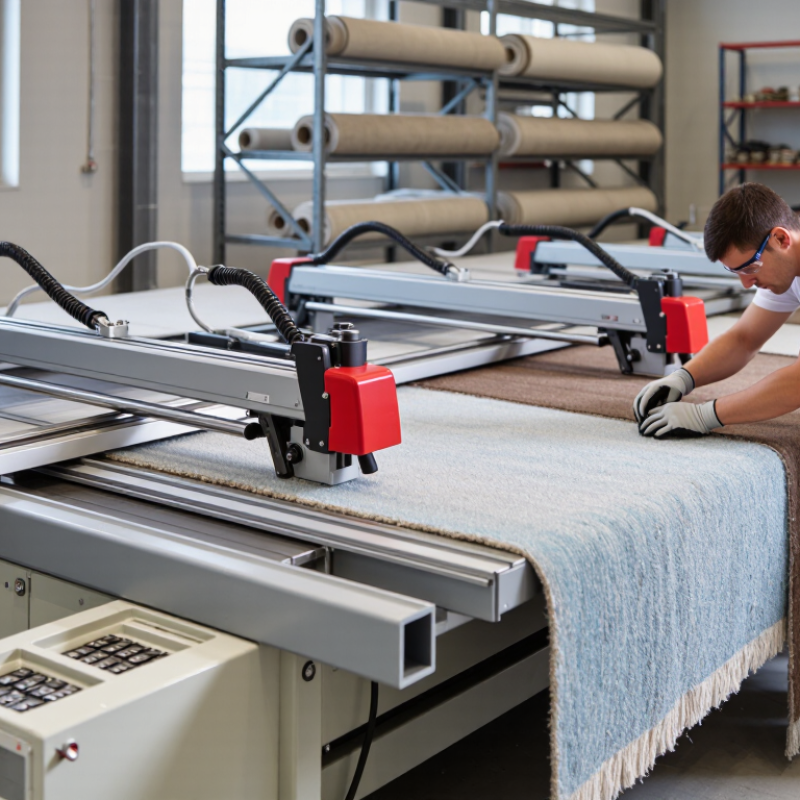
Automated or CNC cutting system A controlled cutting head follows programmed paths using a knife or other compatible cutting tool. Pattern cutting and repeatable cutting of carpet or other flexible sheet materials in production settings. System design may combine a cutting head, motion control, work surface, and software. Tooling is matched to material and process requirements. Calibration, path accuracy, repeatability, safety functions, and cutting results are verified during setup and commissioning.
Common production steps Product-specific processes may include component forming, machining, blade grinding, finishing, assembly, and packaging. Used across hand tools and, where applicable, powered or automated equipment. Materials and processes differ by product design. Metal parts may be stamped or machined; plastic handles may be molded; blades may be ground and treated for their intended use. Typical checks include dimensions, surface condition, assembly fit, blade function, and packaging. Inspection plans and acceptance criteria vary by manufacturer and model.
Specification note: This table describes general product types and manufacturing practices. Blade materials, dimensions, performance, safety features, and inspection procedures vary by model and supplier; confirm exact specifications with the product documentation before purchase.

Key Factors for Evaluating Chinese Carpet Cutter Suppliers

When evaluating Chinese carpet cutter suppliers, compare measured performance, not polished catalogue claims. Ask for repeatability data across thick and thin pile, edge deviation, cutting speed, and blade life. Small details matter. Request a live test using your own carpet roll, backing, and pattern files. Watch for frayed edges, skipped fibers, and drift after repeated passes. Check whether the machine handles your roll width and connects safely with existing conveyors and software.

Supplier credibility also depends on documented quality controls. The ISO Survey 2022 recorded 1,265,216 valid ISO 9001 certificates worldwide, but certification alone cannot confirm cutting accuracy. Ask for the certificate’s scope, a recent calibration record, and sample inspection results.

The International Energy Agency’s Energy Efficiency 2023 report estimates that industry uses about 37% of global energy. This is not a carpet-cutter benchmark, but it makes measured power use worth requesting. Compare energy consumption per operating hour under similar workloads. Test it live. I would still treat supplier-reported figures cautiously until verified on your material; that extra check can reveal setup problems a showroom demonstration misses. Finally, confirm spare-blade availability, technician response times, training, and warranty terms in writing. A low purchase price may become costly when a cutter waits days for service.

How to Source and Compare Carpet Cutters from China

When sourcing carpet cutters from China, compare the tool’s working details, not just its quoted price. Ask suppliers for blade width, cutting depth, handle material, replacement-blade availability, and intended carpet types. A cutter for thin tiles may struggle with dense backing. Small detail, big difference. Request a sample and test it on the carpet you actually install. Check whether the cut stays straight, the blade changes safely, and the handle remains comfortable after repeated passes. Photograph the test and record the material and settings; otherwise, comparisons become fuzzy.

For supplier screening, ask for a current specification sheet, production lead time, minimum order quantity, and packaging dimensions. Ask how incoming materials and finished cutters are inspected. A clear answer should describe checks, not simply promise “good quality.” If possible, compare a sample with the production unit before confirming a larger order. This step can reveal differences in grip finish, blade fit, or edge alignment. Not every supplier will share the same level of detail, and that can slow things down.

Build a simple comparison table covering unit price, sample cost, customization charges, warranty terms, and shipping method. Keep specifications identical when requesting quotations. Otherwise, the cheapest offer may not be equivalent. Confirm carton protection and spare-part supply for your expected usage. I would not treat one smooth sample as proof of consistent production; it is only one data point. Still, it is useful. Ask for updated photos or inspection records, then verify key dimensions on arrival.

Go to Top