Global buyers are entering a more demanding cable tray market in 2026. Electrification, data centers, renewable projects, and factory automation are increasing the need for organized power and control wiring. The International Energy Agency’s Electricity 2024 report projects global electricity demand will grow by an average of 3.4% annually through 2026. That growth creates pressure on infrastructure teams to select systems that remain safe, accessible, and adaptable.
The choice is not simply between ladder, perforated, solid-bottom, wire mesh, and channel designs. Each cable tray type affects ventilation, cable support, installation speed, corrosion resistance, and maintenance access. IEC 61537 defines testing and performance requirements for cable tray systems and cable ladder systems. NFPA 70 also provides widely recognized installation guidance for electrical conductors and raceways in the United States. Regional standards still differ. Check the project rules carefully.
In practical procurement, galvanized steel may suit an indoor factory, while aluminum can reduce weight in coastal or rooftop applications. Stainless steel often performs better where salt, chemicals, or frequent washing are present. Wire mesh can simplify routing changes, but it may not fit every heavy-duty cable arrangement. A neat catalogue is not enough. Buyers should compare load ratings, span distances, finish quality, accessories, grounding provisions, and supplier testing records. Market studies from Grand View Research and MarketsandMarkets indicate continuing growth in cable management demand, although their market definitions and forecasts vary. That difference deserves attention. The best 2026 choice is not always the cheapest tray; it is the system that matches local conditions, verified standards, installation skill, and long-term maintenance expectations.
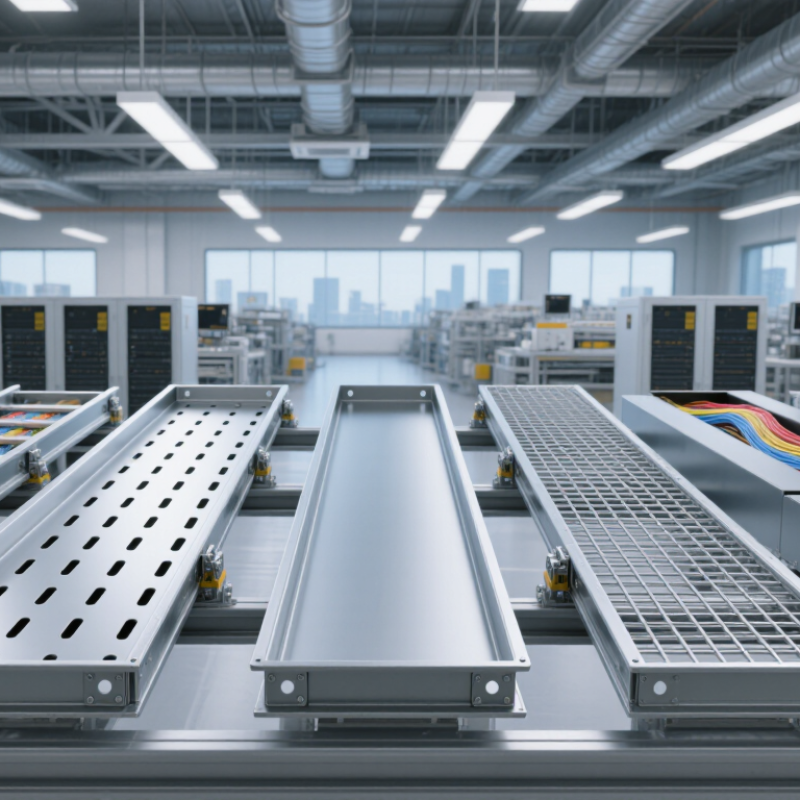
Cable trays are structured pathways that support and protect power, control, and communication cables. In modern electrical systems, they improve airflow, simplify inspection, and reduce installation time. The main types include ladder, perforated, solid-bottom, wire-mesh, and channel trays. Each design serves a different condition. Ladder trays suit heavy power cables because their open rungs support ventilation and easy access. Perforated trays offer better containment for smaller cables. Solid-bottom trays protect sensitive wiring from falling dust and dripping liquids.
Material selection matters. Galvanized steel is common for indoor industrial areas, while aluminum can reduce weight and resist certain corrosive environments. Stainless steel may be more suitable near coastal facilities or chemical exposure. Buyers should check load capacity, span length, cable fill, edge protection, and bonding requirements. IEC 61537 can provide useful guidance, but local electrical codes still control final installation decisions. A tray that looks strong may deform when overloaded.
Tips: Measure the route before ordering. Leave spare capacity for future cables. Check supports at bends and vertical sections. Confirm corrosion resistance with the actual site conditions. In practice, no layout is perfect. I have seen small access gaps become major maintenance problems. Keep separation between power and data cables where required, and inspect joints, covers, and grounding paths before energizing the system. Weather, labor skills, and replacement access should influence the choice as much as price.
For global buyers in 2026, cable tray selection should begin with structure, not appearance. Ladder trays use two longitudinal rails and regularly spaced rungs, allowing strong airflow and easy cable access. They suit power cables and long industrial routes. Perforated or ventilated trays provide a continuous base with openings. Their smaller gaps support control cables and reduce sagging. Solid-bottom trays offer the greatest surface support and shielding, but they retain more heat and require careful cable derating.
Channel trays are compact and practical for short runs, especially near panels and equipment. Wire-mesh trays use welded steel wires, making them light and flexible during installation. However, they may need extra supports under heavier cable bundles. According to IEC 61537, tray systems should be assessed for mechanical strength, electrical continuity, and safe loading under defined test conditions. A 2024 MarketsandMarkets report estimates the global cable tray market will grow at roughly 7% annually through the decade, driven by data centers, factories, and power infrastructure.
Material changes the structure, too. Galvanized steel offers high rigidity and impact resistance. Aluminum reduces handling weight and performs well where corrosion is a concern. Stainless steel is stronger in aggressive environments, but its cost can be difficult to justify. I have seen designs fail because engineers selected by width alone. That is an avoidable mistake. Span length, cable weight, thermal expansion, support spacing, and local loading rules should be checked together. Some projects still specify oversized trays without testing actual fill conditions. That approach deserves reconsideration.
This chart compares the typical structural features of five widely used cable tray types. A value of 1 means the feature is normally present in the standard configuration, while 0 means it is not a defining feature. Actual products may vary by application, load requirement, material, and ventilation design.
Choosing the right cable tray starts with the installation environment, not the product catalogue. Ladder trays suit power cables in industrial plants because they improve ventilation and simplify access. Perforated trays work well for control and communication cables in indoor facilities. Solid-bottom trays offer stronger protection against dust and falling particles, but they retain more heat. That trade-off matters.
Outdoor projects demand closer inspection. Hot-dip galvanized steel can resist ordinary weather, while aluminum reduces weight and supports faster installation. Coastal or chemical areas may require stainless steel or fiber-reinforced plastic trays. Check temperature, humidity, salt exposure, ultraviolet radiation, and chemical vapors before selecting materials. A clean-looking tray can still corrode quickly.
Load capacity and cable separation deserve equal attention. The MarketsandMarkets report Cable Management Market—Global Forecast to 2028 projects growth from about USD 23.3 billion in 2023 to USD 36.9 billion by 2028. This expansion reflects heavier infrastructure demand, but market growth does not replace engineering judgment. Follow NEMA VE 1 and IEC 61537 for mechanical performance, loading, and testing guidance. NFPA 70 also provides important installation requirements in applicable projects. Leave practical space for future cables. Too little space creates heat, congestion, and difficult maintenance. Too much space raises cost. That balance is easy to underestimate. Some designs also overlook bonding continuity at joints. Field verification remains essential, especially where drawings differ from actual site conditions.
| Cable Tray Type | Typical Material / Finish | Best Installation Environments | Ventilation | Cable Access | Main Advantages | Main Limitations | Selection Notes |
|---|---|---|---|---|---|---|---|
| Ladder Cable Tray | Steel, aluminum, or stainless steel; galvanized, painted, or other specified protective finishes | Industrial plants, substations, utility facilities, tunnels, and long cable routes | Excellent; open rungs provide strong air circulation | Excellent; cables can be installed or removed from the top | High load capacity, good heat dissipation, easy inspection, and convenient cable tie-down | Provides limited protection from dust, falling objects, impact, and water | Check rung spacing, span rating, deflection limits, and support spacing for the actual cable load |
| Perforated or Ventilated Trough Tray | Pre-galvanized steel, aluminum, stainless steel, or coated steel | Commercial buildings, factories, data rooms, control systems, and medium-density power distribution | Good; perforations improve airflow and allow drainage | Good; top access is generally straightforward | Balanced protection, ventilation, flexible cable fastening, and broad availability | Usually has less load capacity than a comparable heavy-duty ladder tray | Use solid or reinforced versions where cable weight, impact, or small-object protection is more demanding |
| Solid-Bottom Cable Tray | Galvanized steel, aluminum, stainless steel, or corrosion-resistant coated steel | Instrumentation areas, control rooms, indoor industrial spaces, and routes requiring a continuous base | Moderate to limited, depending on cover and cable fill | Good from the top; side access depends on the installation layout | Reduces cable sag, supports small cables, and offers better shielding from falling debris | Lower heat dissipation than open designs; drainage and cable temperature must be considered | Avoid excessive cable fill and verify the allowable ampacity adjustment for grouped cables |
| Wire Mesh Cable Tray | Welded steel wire with zinc, stainless steel, or other specified corrosion-resistant finish | Data centers, telecommunications rooms, raised-floor areas, and low-voltage cable routes | Excellent; open mesh provides high airflow | Excellent; cables can enter from almost any direction | Lightweight, easy to cut and route, highly adaptable, and suitable for frequent changes | Not ideal for very heavy power cables or locations requiring strong impact protection | Select mesh size, wire diameter, edge protection, and load rating according to cable type and support span |
| Channel Cable Tray | Galvanized steel, aluminum, stainless steel, or coated sheet metal | Short runs, branch circuits, wall-mounted routes, and areas with a small number of cables | Moderate; openings and cover design affect cooling | Good for small cable quantities and compact routes | Compact, economical, and suitable where installation space is limited | Limited capacity and less suitable for large cable bundles or long unsupported spans | Confirm internal width, bend radius, cover clearance, and fastening requirements before ordering |
| Fiberglass-Reinforced Polymer Tray | Glass-fiber-reinforced polymer, commonly with UV-resistant resin for outdoor use | Chemical plants, wastewater facilities, coastal areas, offshore-related installations, and highly corrosive environments | Good; design-dependent ventilation through open or perforated sections | Good; cutting and drilling procedures differ from metal systems | Strong resistance to many chemicals, moisture, salt spray, and galvanic corrosion; electrically nonconductive | Lower temperature capability and different structural behavior than metallic trays; UV suitability must be verified | Review resin type, fire performance, UV rating, temperature range, and support-span data |
| Stainless Steel Cable Tray | Stainless steel selected according to the chemical, chloride, and temperature exposure | Food processing, pharmaceutical production, marine atmospheres, cleanable areas, and corrosive industrial facilities | Good to excellent, depending on tray configuration | Good; open designs provide easy inspection and maintenance | High corrosion resistance, durable surface, and good cleanability | Higher material cost; incorrect grade selection can still result in corrosion | Consider chloride concentration, cleaning chemicals, weld quality, and compatibility with adjacent metals |
| Aluminum Cable Tray | Extruded or formed aluminum, commonly supplied with a mill or specified protective finish | Roofs, bridges, coastal projects, lightweight structures, and installations where manual handling is important | Excellent in open configurations | Excellent; lightweight sections are generally easy to modify | Low weight, good natural corrosion resistance, and convenient handling | Lower stiffness than steel in some designs; galvanic corrosion can occur when improperly connected to dissimilar metals | Check thermal expansion, deflection, joint design, and isolation from incompatible metals |
| Covered Cable Tray System | Steel, aluminum, stainless steel, or polymer tray with a removable cover | Outdoor routes, dusty facilities, areas with dripping liquids, and locations requiring additional mechanical protection | Variable; cover selection and ventilation openings strongly affect heat dissipation | Moderate; the cover must be removed for many maintenance tasks | Helps reduce contamination, sunlight exposure, falling debris, and accidental contact | Can increase heat retention, weight, cost, and maintenance time if poorly ventilated | Use covers for a defined environmental need and verify cable ampacity, drainage, wind uplift, and access requirements |
2026 Best Cable Tray Types for Global Buyers?
Cable Tray Materials, Coatings, and Performance Requirements
For global buyers, cable tray selection starts with the site, not a catalog. Galvanized steel suits dry indoor rooms and moderate industrial exposure. Hot-dip galvanizing provides a thicker zinc layer for outdoor routes, loading bays, and humid utility areas. Aluminum reduces weight and resists many corrosive atmospheres. It can be useful on rooftops. Stainless steel serves demanding chemical, coastal, and food-processing environments. Material choice remains a balance between strength, corrosion risk, installation effort, and total service life.
Coatings deserve measurable requirements. Specify coating type, thickness, adhesion, and repair procedures after cutting or drilling. Powder coating may improve appearance and add protection, but damaged edges still need attention. For severe exposure, buyers should define the corrosivity category, temperature range, moisture, salt, and chemical contact. Do not rely on color alone. In site inspections, white rust under stored galvanized trays often signals poor packaging or trapped moisture. That detail is easy to miss.
Performance requirements should cover load capacity, span, deflection, electrical continuity, and fire behavior where applicable. Ask for tested data under the intended support spacing, not only a maximum load figure. Cable fill and thermal spacing also affect real performance. Standards such as IEC 61537 or NEMA VE 1 can support comparison, but local project rules may differ. A tray may pass a laboratory test and still fail through poor joints, missing covers, or rushed installation. Specifications need honest review.
For global buyers, cable tray selection begins with the installation environment, not the catalog photograph.
IEC 61537:2023 covers cable tray systems, including mechanical strength, electrical continuity, and corrosion performance.
NFPA 70, Article 392, provides additional requirements for installations following U.S. electrical practice.
These standards are not interchangeable. A buyer should request test evidence, material certificates, and local compliance records before comparing prices.
Sizing should include cable weight, span length, bending space, ventilation, and future capacity.
Measure the real cable outside diameter, then calculate usable tray width and loading area. Many projects reserve about 20–30% spare capacity, although this is a planning practice rather than a universal legal rule.
Never treat fill space as load capacity. A heavily filled tray may pass a basic width check but fail its support spacing. It happens more often than buyers admit.
The IEA Electricity 2024 report projects data-centre electricity demand could more than double by 2030, reaching about 945 TWh. That growth increases the need for dense, well-organized power and control routing.
Buyers should evaluate ladder, perforated, solid-bottom, and wire-mesh designs against heat release, dust exposure, cable diameter, and maintenance access.
Ask for load-deflection test results, coating thickness, salt-spray data, earthing continuity, and installation drawings.
A lower price can hide thinner steel, weaker joints, or incomplete testing.
In practice, documentation is often the weakest link.
Contact Us