

Blog
2026 Best EVA Machine for Global Buyers
Choosing the 2026 Best EVA Machine for Global Buyers requires more than comparing catalog prices. EVA production can involve footwear soles, foam sheets, packaging components, and custom molded parts. Each application demands different heating, pressure, mold, and cooling performance.
A reliable EVA Machine should deliver stable temperature control and repeatable results across long production cycles. Buyers should examine screw design, hydraulic or servo systems, mold compatibility, cycle time, energy consumption, and operator safety features. Ask for test samples, not only polished videos. A clear sample can reveal uneven density, flashing, surface marks, or incomplete molding.
No machine fits every factory.
Supplier experience also matters. Review installation records, customer references, spare-parts availability, training plans, and response times. A strong manufacturer should explain maintenance intervals in practical terms. It should also provide electrical specifications and documentation for the buyer’s region. Conformity requirements may vary between countries, so independent verification remains important.
Some purchasing decisions still go wrong. Buyers may focus on the lowest quotation and overlook tooling costs, shipping conditions, or service limitations. I have seen equipment appear efficient during testing but perform differently under local materials and working conditions. That possibility deserves attention. The best choice balances production capacity, product quality, energy use, workforce skill, and long-term support. This guide compares key EVA Machine features and supplier considerations, helping international buyers make a more informed and realistic investment in 2026.
What Is an EVA Machine and How Does It Work?
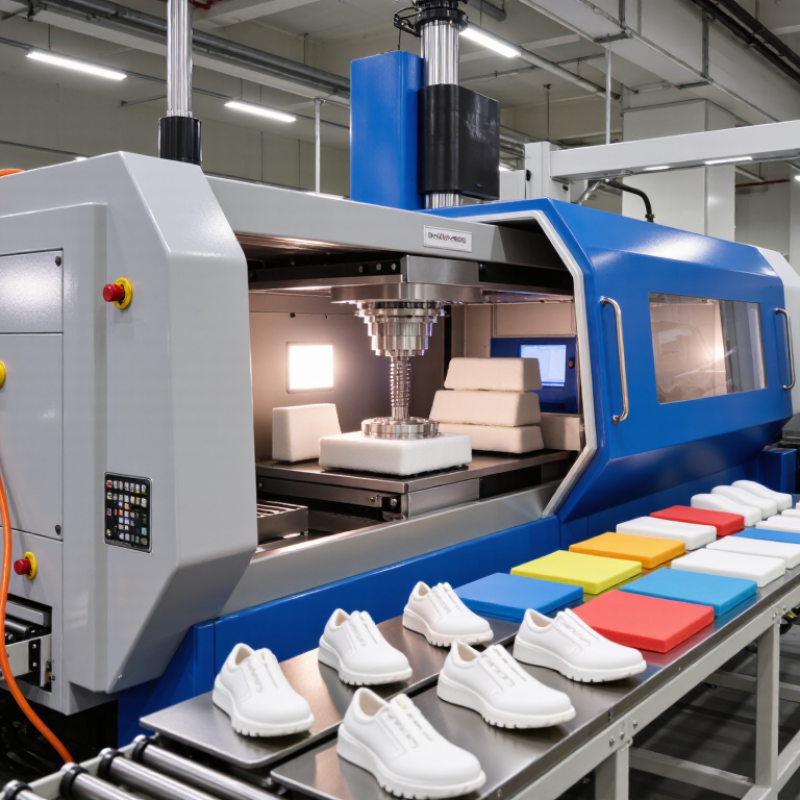
An EVA machine processes ethylene-vinyl acetate into flexible products such as soles, mats, seals, and protective parts. The term is not perfectly standardized. Some machines foam EVA sheets, while others mold finished components. Global buyers should confirm the process before comparing specifications.
The working cycle usually begins with measured EVA pellets and selected additives. A heated barrel softens the material. A screw then mixes and pushes it forward. In injection systems, the melt enters a closed mold under controlled pressure. In compression systems, operators place prepared material into a heated cavity. Heat and pressure shape the part. Cooling then stabilizes its dimensions.
Foaming needs closer control. A chemical or physical foaming agent creates small cells inside the material. Temperature, pressure, and curing time affect density, softness, and rebound. Too much heat may damage the surface. Too little heat can leave weak or uneven foam. It happens.
In practical purchasing, ask for test samples, energy data, mold limits, and operating records. A machine may perform well in a showroom but struggle with local power conditions or inconsistent raw materials. I would also inspect temperature sensors, hydraulic protection, cleaning access, and spare-part availability. These details seem minor until production stops. EVA processing is repeatable, but never completely automatic. Skilled adjustment still matters, especially when changing color, density, or product thickness.
2026 Best EVA Machine for Global Buyers - What Is an EVA Machine and How Does It Work?
| Data Dimension | Typical Technical Data | What It Means | Global Buyer Considerations |
|---|---|---|---|
| What Is an EVA Machine? | Industrial equipment used to process ethylene-vinyl acetate (EVA) compounds into foam sheets, shoe soles, insoles, sports products, packaging materials, seals, and molded components. | The machine applies controlled heat, pressure, and sometimes chemical or physical foaming technology to shape and expand EVA material. | Select the machine according to the final product, required density, mold size, production volume, and local electrical standard. |
| How It Works | Material preparation → mixing or compounding → preheating or plasticizing → molding or extrusion → foaming and expansion → cooling → trimming and inspection. | EVA pellets, sheets, or compounded blends are heated until processable, shaped under controlled conditions, and cooled to stabilize dimensions. | A stable temperature profile, accurate pressure control, and consistent cooling are essential for uniform cell structure and product dimensions. |
| Compression Molding Machine | Typical clamping force: 100–500 metric tons Platen size: approximately 500 × 500 to 1,800 × 1,200 mm Operating temperature: approximately 140–180°C Typical cycle: about 8–30 minutes | Pre-weighed EVA material is placed in a mold. The heated platens close, apply pressure, and cure or foam the material before cooling and demolding. | Suitable for shoe soles, sheets, mats, blocks, and custom molded parts. Larger platens improve output but increase installation space and energy demand. |
| EVA Injection Molding Machine | Typical clamping force: 100–400 metric tons Injection capacity: approximately 100–1,000 g per shot Material temperature range: approximately 150–190°C Typical cycle: about 3–15 minutes | Plasticized EVA is injected into a closed mold, where heat, pressure, and controlled expansion form the finished component. | Useful for repeatable, high-volume molded products. Confirm mold compatibility, shot weight, injection pressure, and automatic demolding requirements. |
| EVA Extrusion Foaming Line | Typical screw diameter: approximately 65–150 mm Typical output: about 80–600 kg/h Common product width: approximately 600–2,000 mm Typical product thickness: about 1–20 mm for sheets | A screw melts and mixes EVA compound before the material passes through a die. Foaming occurs through a chemical blowing agent or controlled physical-gas process, followed by cooling and sizing. | Best for continuous sheets, rolls, films, and profiles. Check die design, foam density range, line speed, cooling capacity, and edge-trimming system. |
| Foam Density Range | Common EVA foam products: approximately 30–250 kg/m³, depending on formulation, expansion ratio, and end use. | Lower density generally provides lighter weight and higher cushioning; higher density usually provides greater hardness, support, and wear resistance. | Ask for test samples at the target density. Density alone does not define quality; hardness, compression set, resilience, and cell uniformity also matter. |
| Temperature Control | Typical processing and mold temperature range: approximately 140–190°C, depending on EVA grade, blowing system, mold design, and product thickness. | Heating activates melting, cross-linking, or foaming reactions. Cooling fixes the final shape and helps control shrinkage. | Look for multiple heating zones, independent temperature sensors, alarm functions, and uniform platen or barrel temperature. |
| Hydraulic Pressure System | Common system pressure: approximately 100–250 bar, with clamping force selected according to projected mold area and process requirements. | Hydraulic pressure closes the mold and maintains the force needed to prevent flash and achieve consistent product thickness. | Evaluate pressure stability, leakage protection, pump efficiency, emergency-stop functions, and availability of replacement seals and filters. |
| Production Capacity | Compression molding: commonly 10–100 kg/h depending on mold cavities and cycle time Injection molding: commonly 10–80 kg/h Extrusion lines: commonly 80–600 kg/h | Actual output depends on product weight, mold cavity count, cycle time, foam expansion, line speed, and scrap rate. | Use verified production trials rather than catalog output alone. Request output data for the exact EVA formulation and product dimensions. |
| Installed Power | Small molding equipment: approximately 15–40 kW Medium molding equipment: approximately 40–120 kW Extrusion lines: approximately 80–300 kW | Power is used by heaters, hydraulic pumps, extruder drives, cooling systems, mixers, conveyors, and auxiliary equipment. | Confirm voltage, frequency, phase, transformer capacity, peak demand, and local electrical certification before ordering. |
| Automation Level | Manual, semi-automatic, and fully automatic configurations are available. Automatic systems may include PLC control, recipe storage, mold loading, demolding, and data monitoring. | Automation reduces operator variation and can improve cycle repeatability, safety, and labor efficiency. | Choose automation based on labor cost, product variety, required throughput, maintenance skills, and expected return on investment. |
| Mold and Tooling Requirements | Mold materials commonly include aluminum or steel. Tooling must match platen dimensions, cavity layout, venting, cooling channels, and product tolerances. | The mold determines product geometry, surface finish, cavity count, material distribution, and demolding performance. | Confirm mold weight, maximum mold height, daylight opening, ejector design, spare parts, and mold-change time. |
| Quality Control Indicators | Key checks include density, hardness, thickness, tensile strength, elongation, compression set, rebound resilience, dimensional shrinkage, and visual cell structure. | These measurements show whether the EVA product meets its intended cushioning, durability, flexibility, and dimensional requirements. | Define acceptance limits before purchase and request production samples, inspection records, and a documented testing method. |
| Safety Features | Recommended features include emergency stops, two-hand controls, safety doors, pressure relief, over-temperature protection, guarding, alarms, and automatic fault shutdown. | These systems reduce risks from high temperature, hydraulic force, moving platens, rotating screws, and stored pressure. | Verify compliance with the machinery and electrical safety requirements applicable in the destination market. |
| Cooling and Utility Requirements | Depending on the configuration, equipment may require cooling water, compressed air, ventilation, drainage, and stable three-phase electrical supply. | Cooling removes process heat and helps maintain product dimensions, cycle time, and foam stability. | Prepare utility capacity, water quality, ambient ventilation, floor loading, and access for installation and maintenance. |
| Best Machine by Application | Shoe soles and molded parts: compression or injection molding Continuous sheets and rolls: extrusion foaming Small batches and many product shapes: compression molding Large repeat orders: injection molding or continuous extrusion | The most suitable machine is determined by product geometry, required volume, changeover frequency, density range, and acceptable production cost. | Do not select equipment by clamping force or output alone; evaluate the complete process, tooling, utilities, labor, and after-sales support. |
| Recommended 2026 Selection Checklist | Confirm product drawings, EVA grade, target density, hardness, dimensions, daily output, cycle time, mold size, electrical specification, safety requirements, installation conditions, spare parts, and operator training. | A complete technical specification reduces the risk of insufficient capacity, unstable foam quality, excessive energy consumption, and compatibility problems. | Request a test run using the intended formulation and obtain written confirmation of performance, acceptance criteria, warranty scope, commissioning, and documentation. |