

Blog
2026 Best Automatic Bag Feeding Machine for Global Buyers
Choosing the right Automatic Bag Feeding Machine is rarely a simple price comparison. Global buyers must examine bag materials, opening sizes, line speed, product behavior, and local service support. A machine that performs well with flat polyethylene bags may struggle with dusty kraft pouches or slippery laminated film. Small details matter. Sensor placement matters.
Jim Pittas, President and CEO of PMMI, has emphasized, “Automation must improve productivity without sacrificing safety, quality, or flexibility.” This principle remains highly relevant in 2026. A dependable feeder should support stable bag separation, accurate opening, gentle transfer, and quick changeovers. It should also communicate clearly with fillers, sealers, checkweighers, and inspection systems. Poor integration can create stoppages that no brochure mentions.
This guide examines the 2026 best options for international purchasing teams. It considers throughput, servo control, hygienic construction, operator safety, spare parts, documentation, and after-sales training. It also looks beyond impressive production numbers. Can the machine handle a humid factory? Can one operator adjust it without special tools? Are replacement sensors available locally?
There is no perfect machine.
That is worth admitting. A high-speed model may require more technical skill. A flexible model may sacrifice some output. Buyers should request product trials, factory acceptance testing, and realistic performance data before signing an order. They should also confirm compliance with applicable regional standards and packaging requirements. The strongest choice is not always the fastest one. It is the Automatic Bag Feeding Machine that performs consistently under real production conditions, with measurable support behind it.
What Is an Automatic Bag Feeding Machine?
An automatic bag feeding machine is packaging equipment that supplies pre-made bags to a filling line. It does not manufacture bags. This distinction matters.
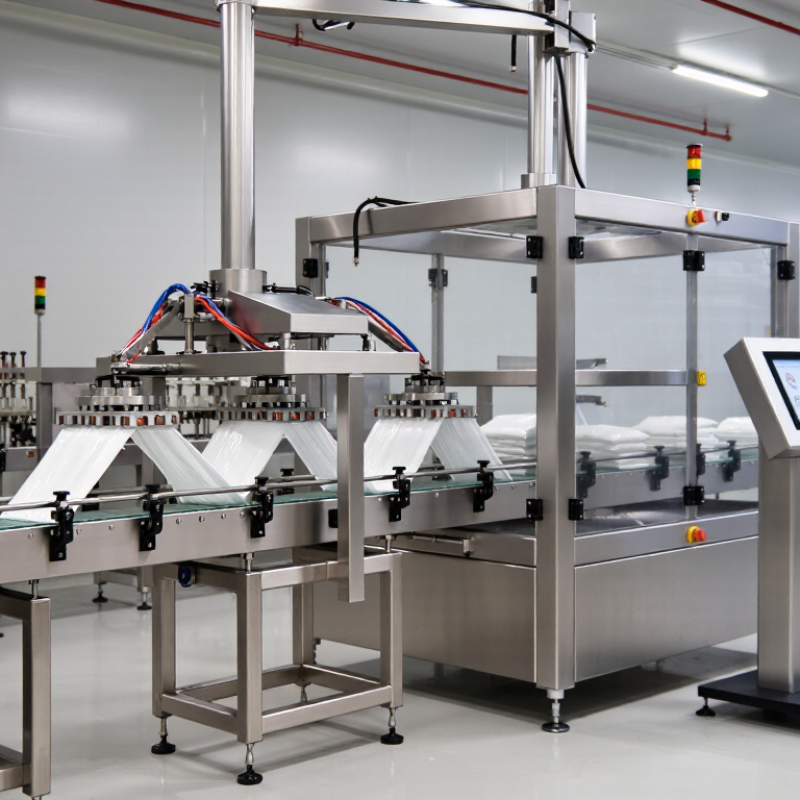
The machine stores flat bags in a magazine or loading tray. A gripper, belt, or vacuum device picks one bag at a time. It separates the bag, opens its mouth, and positions it for filling. Sensors confirm the bag’s presence and alignment. The next machine may add food, powder, granules, or other permitted products before sealing. The process reduces repetitive hand loading and keeps the line moving at a controlled speed.
A dependable system needs adjustable guides, stable vacuum pressure, and accurate timing. Servo-driven movement can improve positioning, but it may increase maintenance requirements. In dusty workshops, filters and accessible cleaning points are important. Small errors matter. A slightly bent bag can cause poor opening or a weak seal.
Global buyers should check bag dimensions, material, thickness, opening style, and required speed. Ask for tests using your actual bags. Sample trials reveal problems that brochures often hide. In practical production, a machine may perform well with one bag shape and struggle with another. Operators also need clear controls, safety guards, spare parts, and service instructions. A lower purchase price may become expensive when changeovers are slow or support is unavailable.
2026 Best Automatic Bag Feeding Machine for Global Buyers - What Is an Automatic Bag Feeding Machine?
| Data Dimension | Typical Data or Specification | Practical Information for Global Buyers |
|---|---|---|
| Machine Definition | Automated system for separating, picking, opening, and transferring pre-made bags | An automatic bag feeding machine supplies empty bags to a filling, weighing, sealing, or packaging machine in a controlled sequence. It is different from a form-fill-seal machine, which makes bags from a continuous film roll. |
| Compatible Bag Types | Flat pouches, stand-up pouches, zipper bags, gusseted bags, and some spouted pouches | Compatibility depends on bag stiffness, opening design, zipper position, spout geometry, and the feeding grippers or vacuum cups used by the machine. |
| Typical Bag Width | Approximately 80–300 mm | The usable range varies by model. A buyer should confirm the minimum and maximum bag width, including the tolerances of the bag supplier. |
| Typical Bag Length | Approximately 120–400 mm | Longer bags may require a larger magazine, additional support, or a modified transfer path to prevent folding and misalignment. |
| Common Bag Material | Laminated plastic film, polyethylene, polypropylene, polyester laminates, aluminum-laminated film, and paper-laminate structures | Surface friction, static electricity, sealant layers, and bag stiffness directly affect separation and reliable feeding performance. |
| Typical Bag Thickness | Approximately 60–180 micrometres for many flexible pouches | Very thin bags can stick together, while thick or rigid bags may need stronger vacuum handling, wider grippers, or slower acceleration. |
| Standard Feeding Speed | Approximately 20–60 bags per minute | This range is common for general-purpose systems and depends on bag size, pouch construction, product line layout, and the number of handling stations. |
| High-Speed Feeding Capability | Approximately 60–100 bags per minute in optimized configurations | Higher speeds normally require stable bag dimensions, accurate magazine loading, synchronized controls, and reliable vacuum or mechanical separation. |
| Feeding Accuracy | Typically about ±1–2 mm under stable operating conditions | Actual positioning accuracy depends on bag quality, sensor resolution, conveyor design, servo tuning, and the interface with the downstream packaging machine. |
| Bag Magazine Capacity | Commonly 100–300 pre-made bags per loading cycle | Capacity is affected by bag thickness and compressed stack height. A larger magazine can reduce operator loading frequency but may increase machine footprint. |
| Bag Separation Method | Vacuum suction, friction belts, mechanical fingers, or combined systems | Vacuum handling is widely used for flexible bags. Mechanical separation can be useful when bags have difficult surfaces or when static electricity causes double feeding. |
| Compressed Air Requirement | Typically 0.5–0.7 MPa clean, dry compressed air | Air consumption should be checked in litres per minute because vacuum generators, pneumatic cylinders, and air knives can significantly affect the total requirement. |
| Electrical Power | Commonly about 2–5 kW, excluding some external equipment | Power demand varies with servo motors, vacuum pumps, conveyors, heaters, and the number of automated handling stations included in the system. |
| Control System | PLC control with touchscreen HMI, photoelectric sensors, and servo or variable-frequency drive control | Useful functions include recipe storage, bag-count monitoring, fault history, speed adjustment, sensor-status display, and communication with the filling or sealing machine. |
| Changeover Time | Approximately 10–30 minutes for common bag-size changes | Tool-free guides, digital recipe settings, clearly marked adjustment scales, and quick-release components can reduce changeover time and setup errors. |
| Typical Construction | Stainless steel 304 for exposed structural and product-contact areas; anodized aluminum or coated steel for selected non-contact components | Stainless steel 304 is widely used in food and general packaging environments. Stainless steel 316 may be selected for aggressive washdown or corrosive conditions. |
| Suitable Industries | Food, pet food, agricultural products, household chemicals, personal care, pharmaceuticals, and industrial components | The machine is suitable when products are packed in pre-made pouches and the production line requires consistent automatic bag presentation before filling or sealing. |
| Typical Product Applications | Snacks, coffee, powders, grains, frozen foods, sauces, detergents, wipes, pet treats, seeds, and small hardware | Product characteristics such as dust, oil, moisture, temperature, and particle size should be considered when selecting sensors, vacuum components, and cleaning methods. |
| Integration Equipment | Multihead weigher, linear weigher, auger filler, liquid filler, piston filler, checkweigher, metal detector, and case packer | The bag feeder should be matched to the cycle time, infeed height, discharge direction, communication protocol, and safety circuit of the complete packaging line. |
| Typical Machine Footprint | Approximately 1,200–2,500 mm long and 800–1,500 mm wide | Exact dimensions depend on magazine size, conveyor arrangement, bag-opening functions, and whether the unit is installed inline or at an angle to the main packaging machine. |
| Operating Environment | Generally 5–40°C with controlled humidity and a clean, stable floor | Dust, condensation, strong vibration, static electricity, and excessive humidity can reduce feeding reliability and shorten the service life of sensors and pneumatic parts. |
| Food-Safety Considerations | Cleanable surfaces, appropriate materials, protected lubricants, and hygienic machine design | For food applications, buyers should verify applicable local requirements, cleaning procedures, allergen-control measures, and the suitability of all product-contact components. |
| Safety Features | Emergency-stop circuits, guarding, interlocked access doors, overload protection, and fault alarms | Safety functions should be assessed against the regulations applicable in the installation country, such as machinery, electrical, and workplace safety requirements. |
| Common Feeding Faults | Double bags, missed pickup, skewed transfer, pouch collapse, zipper interference, and bag jams | Most faults are related to inconsistent bag dimensions, static charge, poor stack loading, unsuitable vacuum settings, worn suction cups, or incorrect guide adjustment. |
| Maintenance Items | Vacuum cups, belts, grippers, bearings, sensors, pneumatic filters, seals, and conveyor surfaces | Routine inspection and replacement of wear parts help maintain feeding accuracy. Cleaning frequency should reflect the product, dust level, and sanitation requirements. |
| Buyer Evaluation Priorities | Bag compatibility, stable speed, changeover flexibility, integration capability, safety, hygiene, serviceability, and total operating cost | The best machine is not necessarily the fastest model; it should reliably handle the buyer’s actual pouch samples, required output, labor conditions, utilities, and regulatory environment. |
Note: The specifications above represent common industry ranges for automatic pre-made bag feeding systems. Final performance depends on bag dimensions, material structure, pouch quality, machine configuration, operating conditions, and downstream equipment.